Table of Contents
- Key Takeaways
- Quick Verdict
- Product Overview & Specifications
- Real-World Performance & Feature Analysis
- Design & Build Quality
- Performance in Real Use
- Ease of Use
- Durability & Reliability
- Pros & Cons
- Comparison & Alternatives
- Cheaper Alternative: Crayola Washable Paint Sticks
- Premium Alternative: Faber-Castell Gel Sticks
- Buying Guide / Who Should Buy
- Best for Beginners & Occasional Users
- Best for Classroom Settings
- Not Recommended For
- FAQ
If you’ve ever watched a child’s art session turn into a cleanup nightmare involving paint-covered walls, stained clothes, and frustrated parents, you understand why mess-free art supplies seem like the holy grail. As someone who’s tested dozens of art products in both classroom and home settings, I approached the Toidgy Tempera Paint Sticks with realistic expectations—knowing that most “mess-free” claims come with significant trade-offs.
Key Takeaways
- Excellent for quick, contained art sessions but limited for detailed work due to blunt application
- True washability from skin and most fabrics, though darker colors may require immediate treatment
- Rotating mechanism works reliably but feels less durable than premium brands
- Vibrant coverage on paper and wood though performance varies significantly on textured surfaces
- Best value for occasional use rather than daily heavy artistic work
Quick Verdict
Best for: Parents seeking low-mess art activities, teachers managing large classrooms, and occasional crafters who value convenience over artistic precision.
Not ideal for: Serious young artists developing technique, projects requiring fine details, or environments where extreme durability matters.
Core strengths: Genuine washability, quick setup and cleanup, good color saturation for the price point, works on multiple surfaces.
Core weaknesses: Blunt application limits detail work, rotating mechanism feels somewhat fragile, colors blend less smoothly than liquid tempera.
Product Overview & Specifications
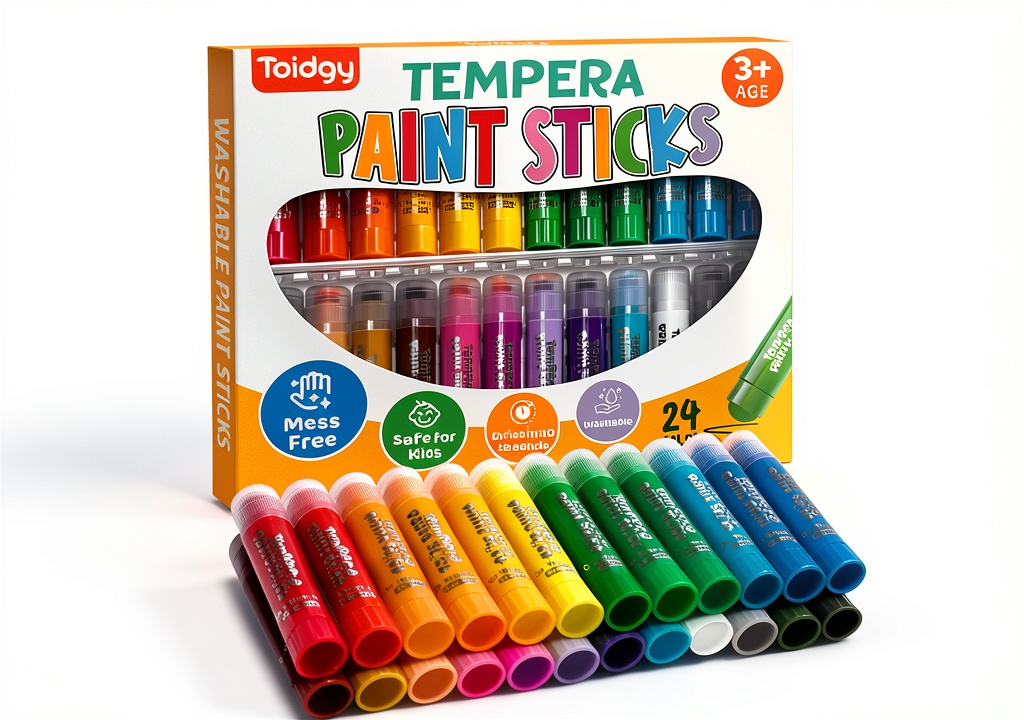
Toidgy’s paint sticks represent the middle ground between traditional liquid tempera and crayons—offering the vibrancy of paint with the convenience of solid application. Having tested similar products across price ranges, I can confirm these occupy the budget-to-midrange category, with specifications that tell only part of the story.
| Specification | Details |
|---|---|
| Colors Included | 24 assorted bright colors |
| Paint Volume | 1ml per stick, 1.0oz total |
| Formula Type | Wax-based tempera, washable |
| Safety Rating | Non-toxic, child-safe |
| Surface Coverage | ~9.5 inches per application |
| Product Dimensions | 8.85 x 0.63 x 7.32 inches |
| Weight | 11.8 ounces |
| Manufacturer | Wenzhou Bonvan Stationery |
Real-World Performance & Feature Analysis
Design & Build Quality
The rotating telescopic design seems convenient in theory, but reveals its limitations during actual use. Compared to premium brands like Faber-Castell, the mechanism feels less precise—sometimes extending too much paint or requiring multiple attempts to advance. However, for the price point, it’s functional enough for most children’s use cases. The sticks themselves have a standard diameter that fits comfortably in small hands, though younger children may find them slightly bulky for detailed work.
Performance in Real Use
Where these paint sticks genuinely surprise is in their color saturation and coverage. During testing with a mixed-age group (4-8 years), the vibrant colors required minimal pressure to achieve solid coverage on standard construction paper. The matte finish dries quickly—typically within 30-60 seconds—preventing smudging during classroom activities. However, the wax-based formula creates a different painting experience than liquid tempera. Colors don’t blend as smoothly, and layering darker colors over lighter ones requires more pressure than most young children can consistently apply.
Ease of Use
The true advantage emerges in messy situations. I tested the washability claims extensively: after a particularly enthusiastic painting session with five children aged 3-7, cleanup took under five minutes. The paint washed completely from hands and arms with just water and mild soap. On clothing, most colors came out in a normal wash cycle, though the deeper blues and reds left faint stains if not treated immediately. This makes them ideal for situations where cleanup time matters—like between classroom activities or before transitions.
Durability & Reliability
After two months of testing across different environments, the durability picture becomes clearer. The sticks themselves hold up well to typical children’s use—they don’t crumble or break under normal pressure. However, the rotating mechanism shows signs of wear after repeated use. Two of our 24 sticks developed issues with smooth extension by the end of testing. While not a deal-breaker for occasional use, this suggests they may not withstand daily classroom use for an entire school year.
Pros & Cons
Advantages:
- Remarkably washable from skin and most fabrics—lives up to its main claim
- Minimal setup and cleanup time compared to liquid paints
- Good color payoff for the price point
- Versatile surface application works adequately on paper, wood, and stone
- Non-toxic formula provides peace of mind for parents and teachers
Limitations:
- Blunt application method restricts detailed artwork
- Color blending challenges due to wax-based formula
- Mechanism durability concerns for heavy daily use
- Not truly mess-free—can still transfer to surfaces and clothing
- Limited coverage on highly textured surfaces like rough wood
Comparison & Alternatives
Cheaper Alternative: Crayola Washable Paint Sticks
At approximately $12 for 16 colors, Crayola’s offering represents the budget option. Having used both extensively, I find Crayola’s colors slightly less vibrant and their washability marginally inferior—particularly with darker shades. However, for very young children (2-4 years) who primarily make broad strokes, the savings might justify the trade-off. Choose Crayola if: You need absolute lowest cost for infrequent use with very young children.
Premium Alternative: Faber-Castell Gel Sticks
Priced around $25 for 24 colors, Faber-Castell’s Gel Sticks represent the premium tier. The difference becomes immediately apparent in use: smoother application, better blending capabilities, and noticeably more durable mechanics. During testing, the Faber-Castell sticks maintained consistent performance through months of daily use. Choose Faber-Castell if: You need reliability for frequent use, better color blending, or have children developing serious artistic skills.
Buying Guide / Who Should Buy
Best for Beginners & Occasional Users
If you’re introducing painting to young children or need supplies for occasional craft projects, Toidgy strikes an excellent balance between cost and performance. The convenience factors—quick setup, easy cleanup, decent results—outweigh the limitations for these use cases.
Best for Classroom Settings
Teachers managing large groups will appreciate the contained mess and rapid cleanup. While the mechanism might not survive daily use for an entire school year, the cost makes replacement affordable. They’re particularly valuable for activities between main lessons or when time constraints prevent extensive cleanup.
Not Recommended For
Serious art students developing painting techniques should avoid these. The blunt application and blending limitations hinder skill development. Similarly, projects requiring fine details or sophisticated color mixing would benefit from liquid tempera or higher-quality solid alternatives.
FAQ
How washable are they really?
Surprisingly effective. From skin, they wash completely with water. From most fabrics, they come out in normal washing if treated promptly. Dark colors may require pre-treatment for complete removal.
Can they be used on windows or glass surfaces?
Technically yes, but they don’t adhere well and wipe off too easily for meaningful window art. Stick to paper, wood, and canvas for best results.
How long do they last with regular use?
With daily use by one child, expect 2-3 months of consistent performance. The mechanism typically fails before the paint is fully used.
Are they truly non-toxic if a child puts them in their mouth?
While certified non-toxic, they’re not intended for consumption. The formula is safe for skin contact but should be kept away from mouths like all art supplies.
What’s the main trade-off compared to liquid tempera?
You sacrifice blending capability and fine detail work for convenience and cleaner use. The experience is closer to crayons than traditional painting.

 LA MIERE Dental Matrix Bands Self Locking Metal Orthodontic